The Focus Window Plan
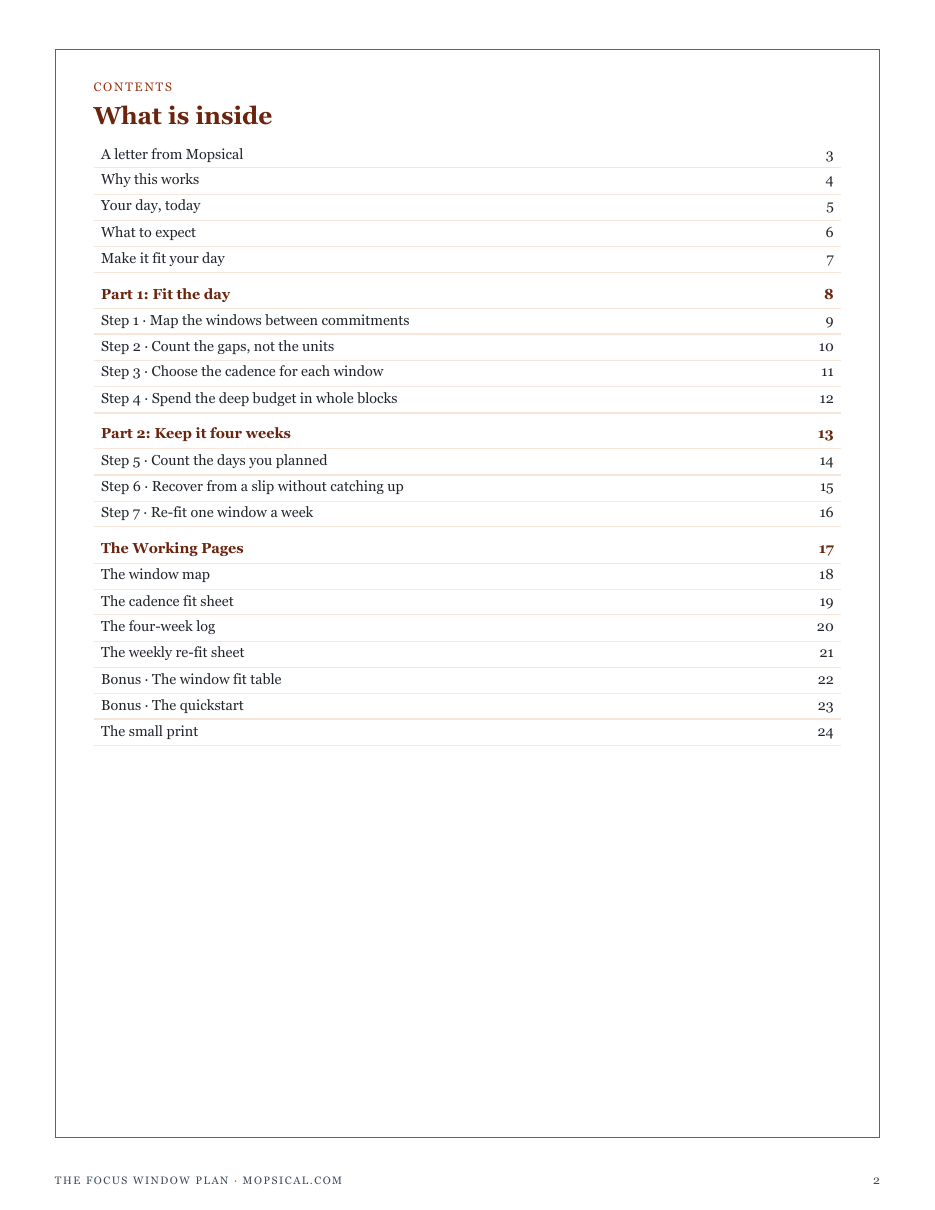
How much focus your real day holds, and how to keep it for four weeks: the windows between your commitments, the blocks each one fits, a cadence per window, a deep budget spent in whole blocks, and consistency counted over the days you planned
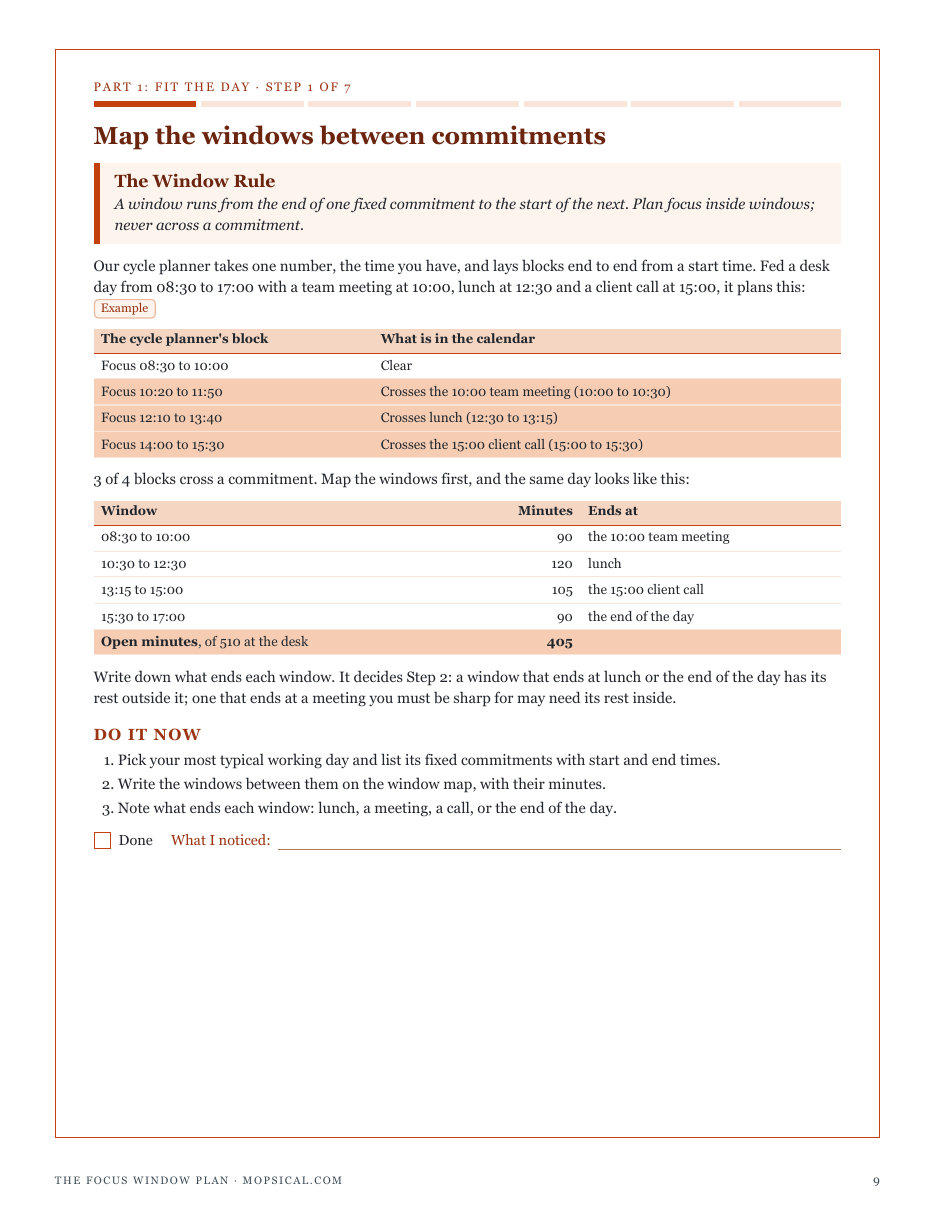
Mopsical's focus session planner is its most used tool, with a cycle planner and a deep-work planner beside it. Each answers how much focus fits in a day, and none of them knows where your meetings are. The cycle planner, fed a whole desk day, runs three of its four blocks through a meeting, lunch and a call, and it keeps a rest after the last block, so a 90-minute window reads zero 90-minute blocks. The deep-work planner budgets 3.4 hours a day and reports two blocks that hold 3. The Focus Window Plan works window by window, in seven steps. On a desk day from 08:30 to 17:00 with a meeting, lunch and a call, it maps four windows of 90, 120, 105 and 90 minutes, counts the gaps instead of the units, and picks the cadence with the most focus in each: 6 h 10 min in five blocks. It spends a 204-minute deep budget in whole windows (190 minutes a day, 15 h 50 min a week) and labels the rest for shallow work. Part 2 keeps the plan four weeks: 12 kept days out of 15 planned weekdays is 80% and on target, where the same record over 21 calendar days reads 57.1% and out of reach, and after a slip it recounts three honest ways on instead of a double day. Every figure is computed from our own calculators. The cadences, the deep share and the 4-hour ceiling are labelled rules of thumb; the plan cites no study, names no app, and is not medical advice or a treatment for any condition. Included: 24 printable pages with seven steps, a window map, a cadence fit sheet, a four-week log, a weekly re-fit sheet, a window fit table and a quickstart, plus a personalised sheet worked from the numbers you enter in our planners and tracker.
Look inside
Two full pages from the pack, exactly as printed. Click either to read it at full size before you decide.
What is in it
- The Window Rule: the open windows between your fixed commitments, and what ends each one
- The Last Break Rule: n blocks need n - 1 rests, so a window holds the blocks that fit by counting the gaps
- The Most Focus Rule: the cadence with the most focus minutes in each window, the longer block on a tie
- The Ceiling Rule: a deep budget spent in whole windows, with the rest labelled for shallow work
- The Planned Days Rule: consistency counted over the days you planned, never the calendar
- The No Catch-Up Rule: after a slip, keep, lower or extend the target, never a double day
- The Weekly Re-Fit Rule: one change a week, to the window that slipped most
- Four working pages: a window map, a cadence fit sheet, a four-week log and a weekly re-fit sheet
- A window fit table (30 minutes to 5 hours, four cadences) and a quickstart
- A personalised sheet worked from the numbers you enter in our focus, cycle and deep-work planners and habit tracker
- ✓ 24 printable pages
- ✓ 10 sections, worksheets and templates
- ✓ A second PDF worked out from the numbers you enter
- ✓ No account needed, just an email address
- ✓ Instant download; link valid 7 days
Price includes any taxes. Sold by GrabURL, who handle checkout and support. The charge appears on your statement as GrabURL.
The pack picks up where the free focus session planner leaves off. The planner lays out sessions from a start time; the pack maps the windows between your fixed commitments first, counts the blocks each window holds without a rest after the last one, and chooses a cadence per window with the cycle planner and the cadence reference. It spends the deep-work budget in whole blocks, then keeps the plan for four weeks with the habit consistency tracker, counted over the days you planned. Cadences and ceilings in it are rules of thumb; it is a planning method, not medical advice or a treatment for any condition.